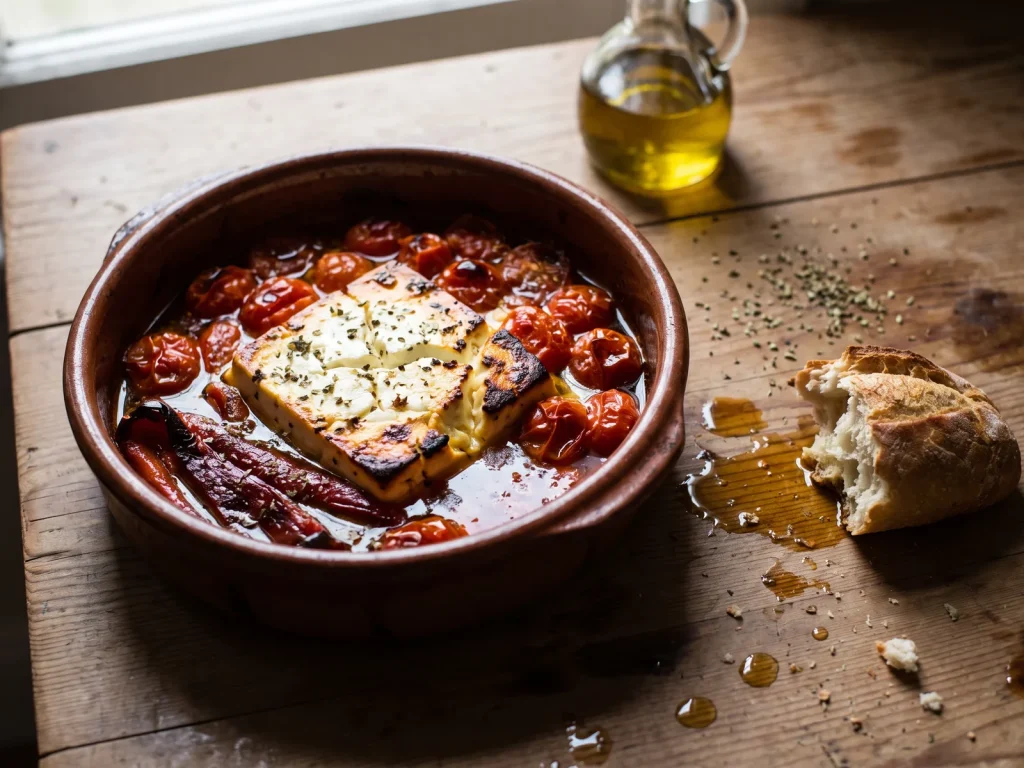
Bouyiourdi is the dish that stands on every Greek table before anything else arrives: a piece of feta in a small clay dish, tomatoes, peppers and chilli around it, olive oil poured over — and the whole thing comes out of the oven once the tomatoes have burst and the oil has formed a sauce with their juice.
The name is a mouthful and gets spelled differently everywhere. In Greece it is mpougourdi or bougiourdi; on German menus you also find it as Boujourdi or Bugurdi. It always means the same thing: melted feta with baked vegetables.
Serves 2–3 as a starter. 10 minutes of work, 20 minutes in the oven — and you need nothing that isn’t already in the kitchen.
| Amount | Ingredient |
|---|---|
| 400 g | feta, in one piece (2 blocks of 200 g) |
| 250 g | cherry tomatoes, halved |
| 1 | red pepper, in narrow strips |
| 1 | small chilli, in rings — or ½ tsp chilli flakes |
| 4–5 tbsp | robust extra virgin olive oil |
| 1 tsp | dried oregano |
| 1 | garlic clove, finely sliced (optional) |
| — | Black pepper. No salt. |
Important: feta is already salty. Add salt and you have ruined the dish before it ever reached the oven. Pepper goes on before baking; salt never does.
Top and bottom heat at 200 °C. If you use a clay dish — and you should — put it in the oven empty. Cold ceramic cracks in a hot oven, and a preheated dish holds the heat more evenly.
Pat the blocks briefly on kitchen paper and lay them in the dish — not cut up, but in one piece. In one piece the centre stays creamy while the edges turn golden brown. Cut up, it dries out.
Lay the halved tomatoes cut side up around the feta, tuck the pepper strips in between, scatter the chilli rings loosely over the top. Everything should surround the feta, not cover it — it has to be able to brown.
Pour the 4–5 tbsp of olive oil evenly over cheese and vegetables and scatter with oregano and pepper. The oil runs down, mixes with the tomato juice there and becomes the sauce as it bakes. Which is why the oil here isn’t an ingredient on the side but the star of the dish.
Into the middle of the oven, 18–22 minutes. It is done when the tomatoes have burst and browned slightly, the feta is soft and has golden patches at the edges. If you want more colour, switch on the grill for the last 3 minutes — but then you stay in front of it, feta burns fast.
Take it out of the oven and leave it to stand. In those five minutes the oil soaks into the cheese and the sauce thickens. Served too early, everything swims in oil; five minutes later it is silky.
Serve with bread. Not as a side, but as a tool: the bread is the spoon.
With bouyiourdi there is no sauce in a pan. The sauce forms in the oven — from olive oil, tomato juice and the fat that leaks out of the feta. Three liquids that have to come together, and that only works with an oil that takes heat and brings flavour.
A robust Koroneiki with a little pungency in the finish cuts through the salty cheese. A mild oil disappears, and what is left is a dish that tastes only of salty cheese. We use our Koroneiki from the 500 ml bottle for this — 4 tbsp of it are not a detail here, they are half the meal. For larger dishes or several portions the 1 litre bottle is worth it.
Cooled and covered it keeps for 2 days in the fridge. Reheat in the oven at 180 °C for 8–10 minutes — not in the microwave, where the feta turns rubbery. Eaten cold, the leftovers make an excellent spread for bread, which not many people know.
A Greek meze of feta baked in the oven with tomatoes, peppers and chilli in olive oil. It comes to the table in the dish it was baked in and is eaten with bread.
Yes, with firm sheep’s cheese or graviera. Not with mozzarella — that melts into a bland sheet. What matters is a salty, fatty cheese that holds its shape.
4–5 tbsp for 400 g of feta. Sounds like a lot, but it is the sauce: the oil combines with the tomato juice in the oven. Less oil means dry bouyiourdi, not a lighter one.
Yes. Layer everything in the dish up to 4 hours ahead, keep it cold and bake it only shortly before eating. Don’t prepare it overnight — the tomatoes draw water and the dish turns watery.
Only as hot as you make it. One small chilli is mild; if you want more, use chilli flakes or two chillies. Without chilli it is a family meal.
Usually the oven is too cool or the time too short. Feta needs 200 °C to turn creamy in the centre. A very lean feta stays firm even at the right temperature — then it was the cheese, not the recipe.