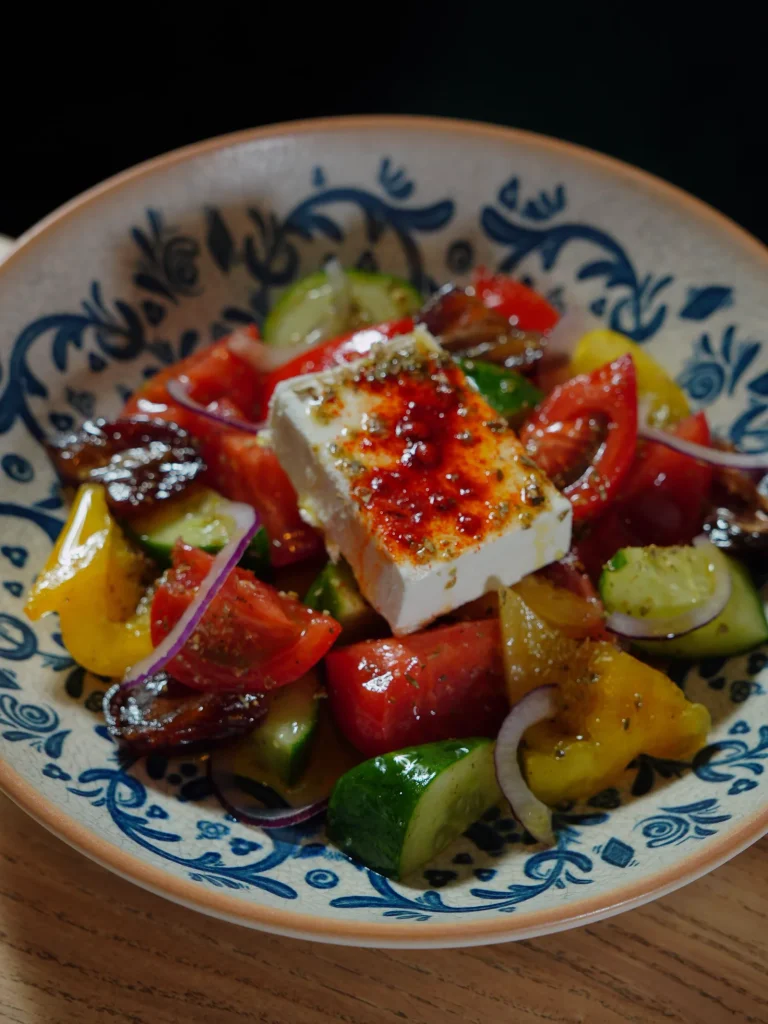
A Greek village salad contains no lettuce. None. What is often called “Greek salad” outside Greece is a mixed salad with feta crumbled on top — a different dish. Horiatiki is five ingredients lying in pieces on the plate, and olive oil that only arrives at the end.
The recipe is this good because it asks for almost nothing: good tomatoes, good oil, salt. And because it takes the summer tomato seriously.
Serves 4 as a side, or 2 as a main course with bread. 20 minutes.
| Amount | Ingredient |
|---|---|
| 6 | Ripe tomatoes (about 800 g), beefsteak or vine tomatoes |
| 1 | Cucumber |
| 1 | Red onion, small |
| 1 | Green pepper, optional |
| 200 g | Feta in one piece (not crumbled) |
| 100 g | Kalamata olives, stone in |
| 4–5 tbsp | Extra virgin olive oil |
| 1 tsp | Dried oregano |
| — | Salt, black pepper |
Cut the tomatoes into irregular pieces — not slices. Put them in a shallow bowl, sprinkle with a good pinch of salt and leave for 10 minutes. The salt draws juice, and that juice becomes the dressing later.
Peel the cucumber or just wash it, halve it lengthways and cut thick half-moons. Slice the onion thinly and soak it in cold water for 5 minutes — that takes the sharpness out and keeps it crunchy.
Add the cucumber, onion, pepper and olives to the tomatoes. Do not mix. The salad should lie in layers so every ingredient keeps its texture.
Place the feta on top as a whole slab or as two thick slices. Do not crumble it. That way it stays creamy, and everyone cuts their own at the table.
Only now pour 4–5 tbsp of olive oil over the salad, scatter oregano, add pepper. Let it sit for a moment, then serve — with bread to soak up the juice.
Horiatiki has no dressing in the proper sense: tomato juice, salt and olive oil are the dressing. There is nothing that could disguise a weak oil. A Koroneiki with green bitterness stands next to the sweetness of the tomato and the salt of the feta — and that tension is what makes the salad.
Ours comes from the 1 litre bottle, on the table every day in summer.
Don’t. A horiatiki is soggy after two hours. Chop up leftovers the next day and eat them with cold rice or as a filling for flatbread — but do not serve them as a salad.
Because horiatiki is a farmer’s dish: tomatoes, cucumber, onion, olives, cheese — whatever grew in the garden in summer. Lettuce came later, in the Greek restaurants built for tourists.
Yes, for the texture. Crumbled or diced feta gives its fat to the salad and dries out.
A strong, cold-pressed extra virgin — not a “mild” oil. The salad has only four flavours, and every one has to carry.