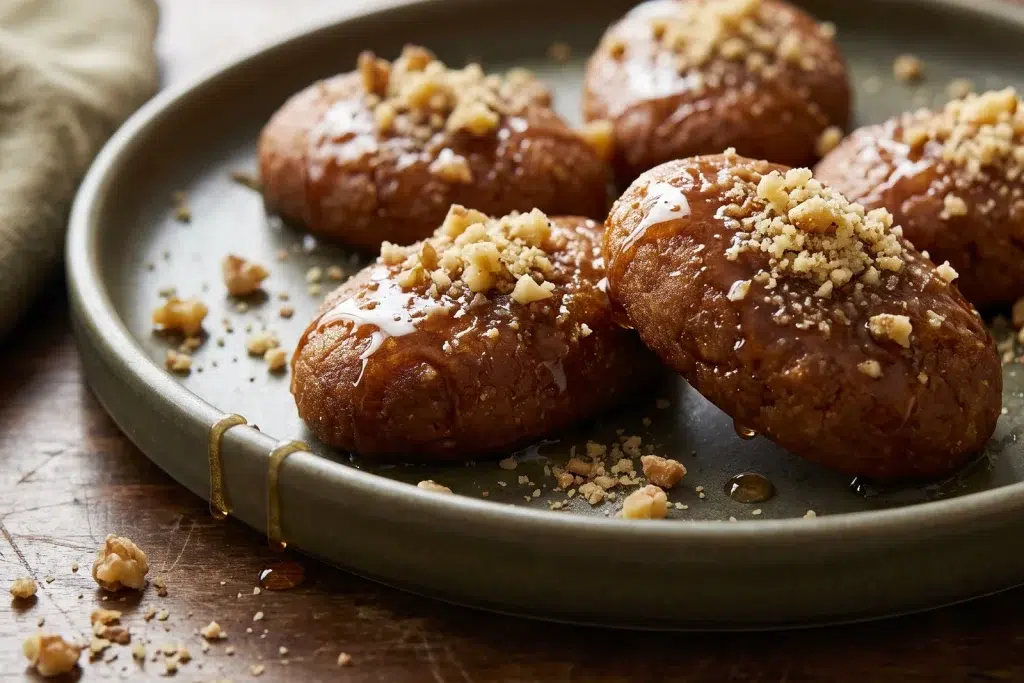
Melomakarona are the other Greek Christmas biscuit — the one that isn’t dusted in icing sugar. Oval, deep golden brown, soaked in honey and covered in walnuts. And they are baked with olive oil, not butter. That is exactly what makes them juicy, spicy and good for weeks.
In Greece people start baking them at the end of November, tray after tray, because they improve every day they sit. After two days in a tin they are soft; by day four they are perfect.
Makes about 45 cookies. 40 minutes of work, 25 minutes in the oven, then at least 6 hours of resting.
| Amount | Ingredient |
|---|---|
| 500 g | Wheat flour, type 550 (plain flour) |
| 100 g | Fine durum wheat semolina |
| 200 ml | Extra virgin olive oil, fruity |
| 120 g | Sugar |
| 150 ml | Freshly squeezed orange juice (about 2 oranges) |
| 1 | Organic orange, zest only |
| 1 tsp | Ground cinnamon |
| ¼ tsp | Ground clove |
| 1 tsp | Baking soda |
| 2 tbsp | Brandy or cognac (optional) |
| 60 ml | Water |
For the syrup: 300 g honey · 200 g sugar · 250 ml water · 1 cinnamon stick · peel of one orange · 1 tbsp lemon juice
To finish: 150 g walnuts, roughly chopped · a little cinnamon
Heat the oven to 180 °C (350 °F) top and bottom heat. Line two baking trays with parchment. They will bake on the middle shelf — melomakarona do not want strong top heat.
Stir flour, semolina, cinnamon and clove together in a large bowl. Don’t sift — just whisk them through so the semolina keeps its texture.
Whisk olive oil and sugar in a second bowl for 2–3 minutes until the mixture looks lighter and creamy. Add the orange zest, the brandy and the water. Dissolve the baking soda in the orange juice — it will foam briefly — and stir that in too.
Pour the wet mixture into the flour and bring it together by hand or with a wooden spoon until you have a soft, oily, glossy dough. Knead only until nothing crumbles any more — two minutes is enough. Kneaded longer, the dough turns tough and the cookies bake hard.
Take walnut-sized pieces, shape them into ovals about 6 × 4 cm and press them flat to 2 cm thick. Set them on the tray and prick each one two or three times with a fork. Those holes are not decoration: they are how the syrup gets inside.
20–25 minutes at 180 °C, until the cookies are an even, deep golden brown. Swap the trays halfway if you are baking two at once. Better a minute early than a minute late — an overbaked melomakarono will not absorb syrup and stays hard.
Bring honey, sugar, water, cinnamon stick and orange peel to the boil and simmer gently for 4 minutes. Add the lemon juice, fish out the cinnamon and peel. Keep the syrup hot — it has to meet the cookies straight from the oven.
Lower the still-hot cookies into the hot syrup with a slotted spoon, leave them 30–60 seconds per side, lift them out and set them on a rack. Scatter the chopped walnuts and a little cinnamon over them immediately, while the surface is still wet.
At least 6 hours, better overnight, in a closed tin at room temperature. The syrup works its way to the centre, the cookies soften and darken. On the second day they taste noticeably better than on the first.
Melomakarona are the only Christmas bake where olive oil is the sole source of fat. There is nothing to hide a weak flavour behind. A fruity oil from an early harvest carries the orange, cinnamon and honey — it makes the cookies spicy rather than merely sweet. A neutral or tired oil leaves them flat, and after two days you can taste it.
We use our Koroneiki from the 500 ml bottle for this — enough for one tray, and the green bitterness keeps the sweetness in balance. For a double batch the litre bottle works out cheaper.
Three to four weeks in a tin at room temperature. Not in the fridge — the honey firms up and the cookies dry out. Layer them with parchment between so they don’t stick together. They freeze well, both before and after the syrup, for about 3 months.
Two causes: baked too long, or the syrup wasn’t hot enough. The cookie has to go into hot syrup while it is hot itself — if it cools on the way, the surface closes and barely absorbs anything.
Three to four weeks in a closed tin. They get softer over the first days, then stay stable.
Yes, with sugar only and a little more water. They taste sweeter and less floral — the honey is not a detail.
A fruity, cold-pressed extra virgin of medium intensity. Very bitter oils push the honey into the background; mild oils disappear completely.
They are edible, but they taste dry. Only after a day or two in the tin are they soft inside and sticky outside — the way they should be.